
Showing posts with label grammar. Show all posts
Showing posts with label grammar. Show all posts
Wednesday, April 8, 2020


Monday, March 9, 2020

Saturday, January 25, 2020

Wednesday, January 8, 2020
Present perfect simple
PRESENT PERFECT: FORM AND USE:


EXERCISES


USE:


- Present Perfect is used for actions in the past which have a connection to the present. The time when these actions happened is not relevant so there is often no time complement.

- Present Perfect is used for recently completed actions. Actions that take place in a recent past.

- Present Perfect is also used for actions beginning in the past that continue up to the present.
EXERCISES
- BBC
- Present perfect man (www.isabelperez.com)
- Exercise 1 (www-englisch-hilfen.de)
- Exercise 2 (www.englisch-hilfen.de)
- English at home: grammar and exercises
- Hot Potatoes exercise
- Unit 3 final test
- Affirmative senteces in present perfect
- Negative sentences in present perfect (www.ego4u.com)
- Sentences with "never" in present perfect (www.ego4u.com)
- Questions in present perfect (www.ego4u.com)
- Exercise: affirmative, negative or question (Perfect English Grammar)
- Exercise 2 : affirmative, negative or question (Perfect English Grammar)
- Choose the right verb form (Using English)
- Choose the right verb (British Council)
- Put the sentences in order
TYPICAL ADVERBS

PAST SIMPLE: FORM AND USE:
- Positive sentence → Subject + verb+ ed or irregular form (I played with her.- She came with us.)
- Questions → Auxiliary verb + subject +verb (Did they read the story?)
- Negative sentence → Subject + auxiliary verb + verb ( I didn’t like it.)

USE:
- For completed action in the past (We saw your sister yesterday.)
- For a series of completed actions (I woke up, had a shower, had breakfast and went to school.)
- For longer actions that start and stop in the past; time expressions usually go with it (My sister lived in London for years.)
- For talking about habits which stopped in the past (She studied Japanese when she was in high school.)
- For past facts or generalizations (Old people never played football.)
PAST SIMPLE & PRESENT PERFECT - CONTRAST


Tuesday, January 7, 2020
Conditional sentences

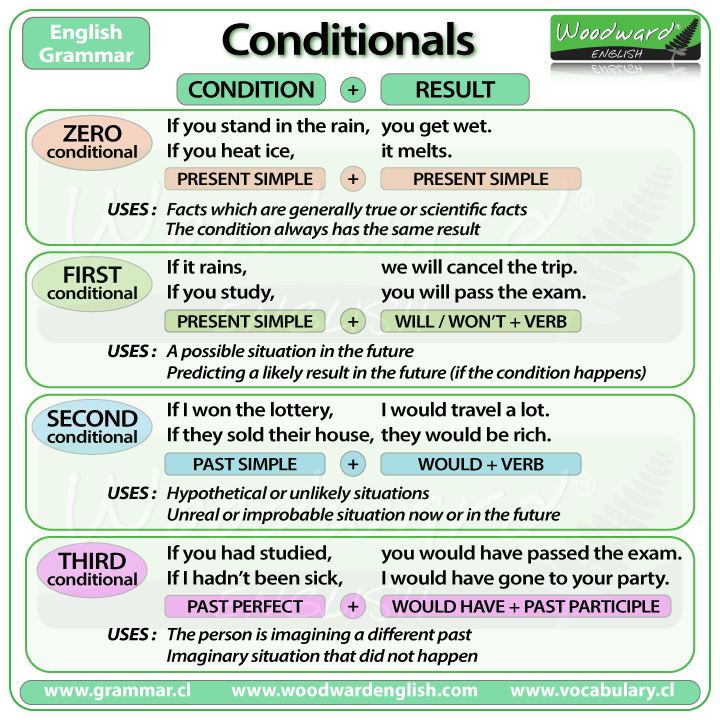
ZERO TYPE CONDITIONAL SENTENCES
MEANING& USE
1ST TYPE CONDITIONAL SENTENCES
MEANING & USE
The first conditional is also called the "real" conditional because it is used for real, or possible, situations. These situations take place if a certain condition is met.
FORM
The first conditional is formed by the use of the present simple in the if clause followed by a comma and a future simple verb (will + infinitive) in the result clause. You can also put the result clause first without using a comma between the clauses.
2nd TYPE CONDITIONAL SENTENCES
MEANING
MEANING& USE
The zero conditional is used to make statements about the real world, and often refers to general truths, such as scientific facts. In these sentences, the time is the present or always and the situation is real and possible.
- If you heat water, it boils.
- Water boils if you heat it.
- When you heat ice, it melts.
- Ice melts when you heat it.
- If it snows, the grass gets white.
- The grass gets white if it snows.
- When it rains, the grass gets wet.
- The grass gets wet when it rains.
FORM
We can make a zero conditional sentence with two present simple verbs (one in the 'if clause' and one in the 'main clause'):
If/when/unless + present simple, .... present simple.
EXERCISES
MEANING & USE
The first conditional is also called the "real" conditional because it is used for real, or possible, situations. These situations take place if a certain condition is met.
In the first conditional we can salso use unless, which means "if... not". In other words, "... unless he hurries up" could also be written, "... if he doesn't hurry up."
 |
| 1st type conditional sentence |
- If it rains, we will stay at home.
- He will arrive late unless he hurries up.
- Sophie will buy a new car, if she gets her raise.
FORM
The first conditional is formed by the use of the present simple in the if clause followed by a comma and a future simple verb (will + infinitive) in the result clause. You can also put the result clause first without using a comma between the clauses.
- If he finishes on time, we will go to the movies.
OR
- We will go to the movies if he finishes on time.
EXERCISES
- exercise 1- Ego4you
- exercise 2- Ego4you
- exercise 3- Englisch Hilfen: statements
- exercise 4- Englisch Hilfen: negatives
- exercise 5- Englisch Hilfen: mixed
- exercise 6- Englisch Hilfen: mixed-two blanks
- exercise 7- ESL Partyland
- exercise 8- Isabel Pérez matching exercise
- exercise 9- English Exercises
- exercise 10- First English
- exercise 11- English Grammar
- exercise 12: Perfect English
2nd TYPE CONDITIONAL SENTENCES
MEANING
 |
| 2nd type conditional sentence |
- If I were a rich woman, I would travel around the world. I think it is very unlikely that I will be rich. However, in this unlikely condition, I will travel around the world.
- If I weren't / wasn't watching TV now, I would be playing tennis. I am watching TV, but I am imagining an alternative activity I would be doing if I wasn't watching TV
- If you had a bigger dog, your house would be protected. You don't have a big dog, but I am imagining how protected you would be if you had one.
- If I were an alien, I would be able to travel around the universe. It is impossible for me to be an alien. However, I am imagining what I would do in this situation.
- We would go to Paris this summer if we passed all our subjects. That is our plan but, unfortunatelly, we know we are not going to pass all our subjects.
If + past simple + conditional (would)
Conditional (would) + if + past simple
Verb be is usually were for all subjects; was (1st & 3rd person) is colloquial.
SONGS
If I were a rich man (Fiddler in the Roof-movie)
If today was your last day (Nickleback)
If I were a boy (Beyonce)
EXERCISES
- Malted ESO-4 unit 7 (Gwineth and the Wizard)
- Exercise 1: unit 5 in your text book
- Exercise 2: write the correct verb forms (1st & 2nd type conditionals)
- Exercise 3: Englisch Hilfen
- Exercise 4: Englisch Hilfen
- Exercise 5: Ego4you
- Exercise 6: Ego4you
- Exercise 7: Ego4you-with auxiliary verbs
- Exercise 8. First English
- Exercise 9: English for you
- Exercise 10: ESL lounge
- Exercise 11: Edu GE
- Exercise 12: Speak Speak
- Exercise 13: English exercises
- Exercise 14: English Area
3RD TYPE CONDITIONAL SENTENCES
MEANING
The first conditional and second conditionals tell us about the future. With the third conditional we refer to the past. We speak about a condition in the past that did not happen. That is why there is no possibility for this condition. The third conditional is also like a dream, but with no possibility of the dream coming true.
- If I had travelled to Italy I would have visited Luca. But I have not travelled to Italy and, therefore, I have not visited Luca.
- If you had got a good mark, would you have complained to the teacher? but your mark was bad, so we don't know for sure what you would have done.
- What would you have done if it had snowed last weekend? but it didn't snow.
- I wouldn't have called if I had known that she wasn't home. but I knew so I called
FORM
 If + past perfect // would have + past participle
Past participle // if + past perfect
EXERCISES
- Englisch Hilfen: statements 1
- Englisch Hilfen: negatives 1
- Englisch Hilfen: mixed
- Englisch Hilfen: mixed with negations
- Englisch Hilfen: easy conditionals
- Englisch Hilfen: medium conditionals
SONGS:
ALL TYPES OF CONDITIONALS
Tuesday, December 17, 2019
Past perfect: form and use
FORM AND USE:

It is used for actions that start in the past and continue up to a given time in the past:


EXERCISES:
PAST PERFECT:

It is used for actions that start in the past and continue up to a given time in the past:

- I had finished the article when they said it was dinner time.
- Yesterday evening at nine o'clock I had already finished the videogame.
- She hadn't arrived when we phoned.
Also in 3rd type conditional sentences:
- If you had asked me, I wouldn't have let you go.
- We wouldn't have solved the quiz if they hadn't helped us.

EXERCISES:
PAST PERFECT:
- Perfect English Grammar
- Ego 4 You
- Oxford University Press
- Englisch Hilfen - statements
- Englisch Hilfen - negatives
- Englisch Hilfen - questions
- Englisch Hilfen - mix

Monday, December 2, 2019

Monday, November 18, 2019
Present simple, present continuous, past simple and past continuous
PRESENT SIMPLE
GRAMMAR:
EXERCISES
- Isabel Pérez-affirmative1
- Isabel Pérez-affirmative2-word order
- Englisch Hilfen-affirmatives1
- Englisxh Hilfen-affirmatives2
- Ego4you affirmatives
- Really Learn English-affirmatives
- Really Learn English-affirmatives2
- Really Learn English-affirmatives3
- Really Learn English-affirmatives4
- Really LEarn English-affirmatives5
READING COMPREHENSION EXERCISES
PRESENT CONTINUOUS
EXERCISES
- affirmative sentences (Englisch Hilfen)
- affirmative sentences2 (Englisch HIlfen)
- negatives (Englisch Hilfen)
- questions (Englisch Hilfen)
- affirmatives-negatives-questions (Englisch Hilfen)
Eso 3-present simple and present continuous (1) from Ana Arias Castro
- EXERCISES
- exercise 1 (Englisch Hilfen)
- exercise 2 (Perfect English)
- exercise 3 (Englisch Hilfen)
- exercise 4 (English page)
- exercise 5 (English Grammar)
- exercise 6 (ESL Lounge)
- exercise 7 (Ego4U-1)
- exercise 8 (Ego4U-2)
- exercise 9 (Ego4U-3)
- exercise 10 (Ego4U-4)
- exercise 11 (Ego4U-5)
- exercise 12 (Ego4U-6)
- exercise 13 (Ego4U-7)
- exercise 14 (Ego4U-8)
- exercise 15 (Ego4U-9)
- exercise 16 (Ego4U-10)
- exercise 17 (Ego4U-11)
- exercise 18 (Ego4U-12)
PAST SIMPLE AND PAST CONTINUOUS
Past simple is often used for past events in a past time. Most stories are told using this tense and it is often used together with past continuous.
Past continuous or past progressive is one of the tenses we are going to study this year.
The following chart summarises the most important aspects you'll have to learn about both of them:

USES:
- Past simple is used to tell about past event or stories:
- We went to Ireland and there we met your sister.
- My parents spent a weekend in Coruña but they didn't go to the port.
- When did they release the film? Last Friday?
- Past continuous is often used to talk about what was happening at a specific time in the past (talking about memories...)
- We were watching the film at lunch time.
- Two past continuous tenses can be used to talk about long, simultaneous actions in the past:
- We were studying while the dogs were barking in the yard.
- Both tenses are used to talk about something that happened at one point (in the past simple) while a longer action was taking place (in the past continuous). In this use, the clause referring to the longer action, is often introduced by while or as; or, alternatively, the shorter action clauses is introduced by when:
- We weren't watching the film when my sister rang.
- They found the lost key as they were having a walk along the river.
- Myrtle broke here leg while she was exercising in the park.
EXERCISES:
past simple
- Revision of regular verbs -englisch-hilfen.de
- Revision of irregular verbs1 -englisch-hilfen.de
- Revision of irregular verbs2 -englisch-hilfen.de
- Revision of irregular verbs3 -englisch-hilfen.de
- Revision of irregular verbs4 -englisch-hilfen.de
- Past simple Boy -www.isabelperez.es
- Questions in the past simple
- Past continuous and past simple exercise -British Council
- Complete with the right affirmative form of past tense-My English Pages
- Write affirmative sentences in past simple (Don't forget punctuation)
- Write these sentences in the negative
- Fill the gaps with past simple forms- Learn English Today
- Fill the gaps with past simple forms - To Learn English
- Present simple or past simple - To Learn English
- Sentences and questions in the past simple1-Englisch Hilfen
- Sentences and questions in the past simple2-Englisch Hilfen
- Past continuous 1
- Past contunuous 2 - statements
- Past continuous 3 - statements
- Past continuous 4 - negative
- Past continuous 5 - questions
- Past continuous 6 questions
- Past continuous use
contrast:
- Past simple versus past continuous 1
- Past simple versus past continuous 2
- Past simple versus past continuous 3
- Past simple versus past continuous 4
- Past simple versus past continuous 5
- Past simple boy (from www.isabelperez.com)
- Lady past continuous (from www.isabelperez.com)
- Choose the right tense exercise (perfect-english-grammar.com)
- Revision exercise for unit 2 (past simple)
Friday, November 8, 2019
Past simple tense
When is the past simple tense used?

More practice
- For completed action in the past (We saw your sister yesterday.)
- For a series of completed actions (I woke up, had a shower, had breakfast and went to school.)
- For longer actions that start and stop in the past; time expressions usually go with it (My sister lived in London for years.)
- For talking about habits which stopped in the past (She studied Japanese when she was in high school.)
- For past facts or generalizations (Old people never played football.)
- Positive sentence → Subject + verb+ ed or irregular form (I played with her.- She came with us.)
- Questions → Auxiliary verb + subject +verb (Did they read the story?)
- Negative sentence → Subject + auxiliary verb + verb ( I didn’t like it.)

More practice
- Irregular verb forms (translations are in French)
- Isabel Perez - grammar and practice
- Verb tense quizz
- Writing sentences in order (Isabel Pérez)
- Fernando Alonso text (Isabel Pérez)
- Shakira's life (Isabel Pérez)
- Thanksgiving day (Isabel Pérez)
Friday, October 25, 2019
Present simple and present continuous

PRESENT SIMPLE
GRAMMAR:

EXERCISES
- Isabel Pérez-affirmative1
- Isabel Pérez-affirmative2-word order
- Englisch Hilfen-affirmatives1
- Englisxh Hilfen-affirmatives2
- Ego4you affirmatives
- Really Learn English-affirmatives
- Really Learn English-affirmatives2
- Really Learn English-affirmatives3
- Really Learn English-affirmatives4
- Really LEarn English-affirmatives5
READING COMPREHENSION EXERCISES

PRESENT CONTINUOUS
EXERCISES
- affirmative sentences (Englisch Hilfen)
- affirmative sentences2 (Englisch HIlfen)
- negatives (Englisch Hilfen)
- questions (Englisch Hilfen)
- affirmatives-negatives-questions (Englisch Hilfen)
- exercise 1 (Englisch Hilfen)
- exercise 2 (Perfect English)
- exercise 3 (Englisch Hilfen)
- exercise 4 (English page)
- exercise 5 (English Grammar)
- exercise 6 (ESL Lounge)
- exercise 7 (Ego4U-1)
- exercise 8 (Ego4U-2)
- exercise 9 (Ego4U-3)
- exercise 10 (Ego4U-4)
- exercise 11 (Ego4U-5)
- exercise 12 (Ego4U-6)
- exercise 13 (Ego4U-7)
- exercise 14 (Ego4U-8)
- exercise 15 (Ego4U-9)
- exercise 16 (Ego4U-10)
- exercise 17 (Ego4U-11)
- exercise 18 (Ego4U-12)
Friday, October 18, 2019
Present continuous

PRESENT CONTINUOUS
EXERCISES
- affirmative sentences (Englisch Hilfen)
- affirmative sentences2 (Englisch HIlfen)
- negatives (Englisch Hilfen)
- questions (Englisch Hilfen)
- affirmatives-negatives-questions (Englisch Hilfen)
Thursday, October 17, 2019
Present simple tense

PRESENT SIMPLE
form
- affirmative: subject + infinitive (+3rd p –(e)s)
- negative: subject + don’t/doesn’t + infinitive
- question: do/does + subject + infinitive
Remember that we only add the –(e)s in the 3rd person affirmative form and that be is an exception: am / is / are
use
- facts and permanent states.
- habits and routines
- 1st type conditional sentences
- stative verbs that are not used in the pres. cont. (see, hear, believe, want, know, understand, think, like, love...)
Key words: how often / always / sometimes / often / never / usually / every day / once a week / twice a month... / if (in conditional sentences)
examples
examples
- Snow melts at
- Harry lives in Liverpool.
- My dog plays football with us.
- Daniel washes his jacket every week.
- We don’t like football.
- She doesn’t understand baseball.
- Do you enjoy dining out?
- Does Rafael Nadal train in the morning?
- If you drink too much you’ll have to go to the toilet.
Thursday, October 10, 2019
Present simple tense
PRESENT SIMPLE
form
- affirmative: subject + infinitive (+3rd p –(e)s)
- negative: subject + don’t/doesn’t + infinitive
- question: do/does + subject + infinitive
Remember that we only add the –(e)s in the 3rd person affirmative form and that be is an exception: am / is / are
use
- facts and permanent states.
- habits and routines
- 1st type conditional sentences
- stative verbs that are not used in the pres. cont. (see, hear, believe, want, know, understand, think, like, love...)
Key words: how often / always / sometimes / often / never / usually / every day / once a week / twice a month... / if (in conditional sentences)
examples
examples
- Snow melts at
- Harry lives in Liverpool.
- My dog plays football with us.
- Daniel washes his jacket every week.
- We don’t like football.
- She doesn’t understand baseball.
- Do you enjoy dining out?
- Does Rafael Nadal train in the morning?
- If you drink too much you’ll have to go to the toilet.
Subscribe to:
Posts (Atom)