This blog has been designed to provide information about the activities held at the social studies bilingual sections in CPI Tino Grandío (Guntín,Spain). The English language and Social Studies teachers have elaborated most of the resources you can see but our "auxiliares de conversa" also have their own page and posts. Therefore everyone is invited to have a look .
Showing posts with label Woodward English. Show all posts

Tuesday, July 10, 2018

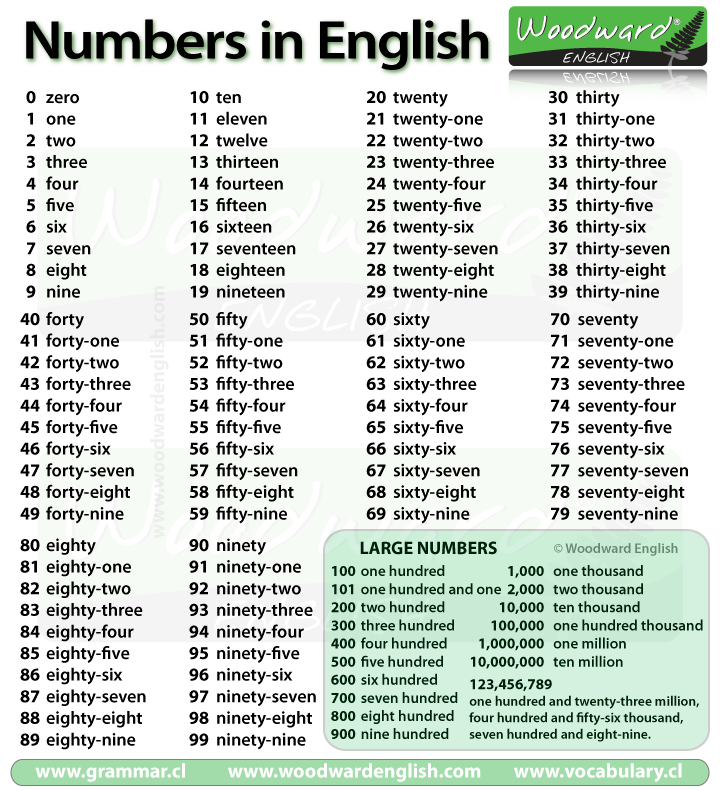
How to read numbers in English

BASIC NUMBERS


Remember that large numbers are separated by commas: 123,456,789 and decimals need dots: 1.25

MORE DIFFICULT NUMBERS
We don't normally write numbers with words, but it's possible to do this and, of course, this will show how we say the numbers.

In writing large numbers, American English uses a comma ( , ) to separate thousands, millions, etc. American English also uses a hyphen ( - ) to separate "tens" words (twenty, fifty, etc.) and
"ones" words (one, three, six, etc.)

Examples:

written   said
1,011   one thousand eleven
   
21,011   twenty-one thousand eleven
   
721,011   seven hundred twenty-one thousand eleven
 ....................................................................................................................................
1,256,721   one million two hundred fifty-six thousand seven hundred twenty-one
   
31,256,721   thirty-one million two hundred fifty-six thousand seven hundred twenty-one
   
631,256,721   six hundred thirty-one million two hundred fifty-six thousand seven hundred twenty-one
 ....................................................................................................................................
1,492,638,526   one billion four hundred ninety-two million six hundred thirty-eight thousand five hundred twenty-six
   
41,492,638,526 forty-one billion four hundred ninety-two million six hundred thirty-eight thousand five hundred twenty-six
   
941,492,638,526  nine hundred forty-one billion four hundred ninety-two million six hundred thirty-eight thousand five hundred twenty-six
__________________________________________________________________

 NOTES:
  1. In American English, the order of large numbers is thousand, million, billion, trillion, etc. (1,000; 1,000,000; 1,000,000,000; 1,000,000,000,000; etc.)
  2. In American English a thousand million is a billion, but in British English, a thousand million is a milliard.
  3. When saying large numbers, do not make thousand, million, billion, trillion, etc. plural. (WRONG: *twenty thousands dollars; *five millions people; CORRRECT: twenty thousand dollars; five million people)
  4. Commas separate thousands, millions, etc. (21,011-31,256,721-941,492,638,526)
  5. People often say "a" instead of "one" before hundred, thousand, etc. and they often add "and" before the last number (a hundred and twenty-one / a thousand and eleven)

DIFFERENCE BETWEEN BRITISH AND AMERICAN ENGLISH (from Wikipedia)
Common British vernacularCommon American vernacularCommon British vernacular
"How many marbles do you have?""What is your house number?""Which bus goes to the high street?"
101"A hundred and one.""One-oh-one."
Here, "oh" is used for the digit zero.
"One-oh-one."
109"A hundred and nine.""One-oh-nine.""One-oh-nine."
110"A hundred and ten.""One-ten.""One-one-oh."
117"A hundred and seventeen.""One-seventeen.""One-one-seven."
120"A hundred and twenty.""One-twenty.""One-two-oh", "One-two-zero."
152"A hundred and fifty-two.""One-fifty-two.""One-five-two."
208"Two hundred and eight.""Two-oh-eight.""Two-oh-eight."
334"Three hundred and thirty-four.""Three-thirty-four.""Three-three-four."
ORDINAL NUMBERS AND FRACTIONS
Ordinal numbers are also used for fractions:
  • 1/10 - one tenth
  • 3/4 - three quarters
  • 15/16 - fifteen sixteenths
SPECIAL NUMBERS

Some numbers have special names in certain contexts:
0:
  • Zero: formal scientific usage
  • Naught / nought: mostly British usage
  • Aught: Mostly archaic but still occasionally used when a digit in mid-number is 0 (as in "thirty-aught-six", the .30-06 Springfield rifle cartridge and by association guns that fire it)
  • Oh: used when spelling numbers (like telephone, bank account, bus line [British: bus route])
  • Nil: in general sport scores, British usage ("The score is two–nil.")
  • Nothing: in general sport scores, American usage ("The score is two–nothing.")
  • Null: used technically to refer to an object or idea related to nothingness. The 0th aleph number (\aleph_0) is pronounced "aleph-null".
  • Love: in tennis, badminton, squash and similar sports (origin disputed, often said to come from French l'œuf, "egg"; but the Oxford English Dictionary mentions the phrase for love, meaning nothing is at risk)
1:
  • Ace in certain sports and games, as in tennis or golf, indicating success with one stroke, and the face of a die, playing card or domino half with one pip
  • Birdie in golf denotes one stroke less than par, and bogey, one stroke more than par
2:
  • Couple
  • Pair
  • Eagle in golf denotes two strokes less than par
  • Duo
3:
  • Trio
6:
  • Half a dozen
12: 
  • A dozen (first power of the duodecimal base), used mostly in commerce
100:
  • A century, also used in cricket scores and in cycling for 100 miles.
  • A ton, in Commonwealth English, the speed of 100 mph[5] or 100 km/h.
120:
  • A great hundred or long hundred (twelve tens; as opposed to the small hundred, i.e. 100 or ten tens), also called small gross (ten dozens), both archaic
144: 
  • A gross (a dozen dozens, second power of the duodecimal base), used mostly in commerce
10100
  • Googol (1 followed by 100 zeros), used in mathematics; not to be confused with the name of the company Google (which was originally a misspelling of googol)
COMBINATIONS OF NUMBERS IN SPORT

  • 1–0    British English: one-nil; American English: one-nothing, one-zip, or one-zero
  • 0–0    British English: nil-nil, or more rarely nil all; American English: zero-zero or nothing-nothing, (occasionally scoreless or no score)
  • 2–2    two-two or two all; American English also twos, two to two, even at two, or two up.

REFERENCE:


Tuesday, September 12, 2017

Hurricanes

A tropical cyclone is a circular air movement over the warm ocean waters in the warm part of Earth near the equator. Most tropical cyclones create strong winds and heavy rains. While some tropical cyclones stay out in the sea, others pass over land. This can be dangerous because they can cause a lot of damage.

Tropical cyclones form when convection causes warm, moist ocean air to rise. They begin as a group of storm winds when the water gets as hot as 80 °F (27 °C) or hotter. The Coriolis effect causes the winds to rotate. These storms usually move westward in the tropics, and later move north or south into the temperate zone. The "eye of the storm" is the center. It has little rain or wind. The eye wall has much rain and the strongest winds. It is surrounded by rain bands and an area of strong winds.

Tropical cyclone, typhoon or hurricane
The term "tropical cyclone" is a general term. In various places they have other local names such as "hurricane" and "typhoon".A tropical cyclone that forms in the Atlantic is called a hurricane The same name is used for those that form in the eastern, central and northern Pacific. In the western Pacific a tropical cyclone is called a typhoon. In the Indian Ocean it is called a "cyclone".

Naming
Tropical cyclones are usually given names because it helps in forecasting, tracking, and reporting. They are named once they have steady winds of 62 km/h. Committees of the World Meteorological Organization pick names. Once named, a cyclone is usually not renamed..

For several hundred years hurricanes were named after saints. In 1887, Australian meteorologist Clement Wragge began giving women's names to tropical cyclones. He drew on history and mythology for names. When he used men's names, they were usually of politicians he hated. By World War II these names were based on the phonetic alphabet (Able, Baker, Charlie). In 1953 the United States stopped using phonetic names and began using female names for these storms. This ended in 1978 when both male and female names were used for Pacific storms. In 1979 the practice was extended to hurricanes in the Gulf of Mexico and the Atlantic.

Impact
Gulfport, Mississippi: damaged city struck by Hurricane Katrina, 2005.
In the past these storms sank many ships. Better weather forecasting in the 20th century let most ships avoid them. When tropical cyclones reach land, they may break things. Sometimes they kill people and destroy cities. In the last 200 years, about 1.5 million people have been killed by tropical cyclones.

Wind can cause up to 83% of the total damages of a storm. Broken wreckage from destroyed objects can become deadly flying pieces. Flooding can also occur when rainfalls and/or storm surges pour water onto land.
There is a possibility of indirect deaths after a tropical cyclone makes landfall. For example, New Orleans, Louisiana suffered from poor sanitary conditions after Hurricane Katrina hit in 2005.[9]

Classifications
Saffir–Simpson Hurricane Scale
Category Wind speeds

  • Five         ≥70 m/s, ≥137 knots ≥157 mph, ≥252 km/h
  • Four 58–70 m/s, 113–136 knots 130–156 mph, 209–251 km/h
  • Three 50–58 m/s, 96–112 knots 111–129 mph, 178–208 km/h
  • Two         43–49 m/s, 83–95 knots 96–110 mph, 154–177 km/h
  • One          33–42 m/s, 64–82 knots 74–95 mph, 119–153 km/h

Related classifications

  • Tropical storm         18–32 m/s, 34–63 knots 39–73 mph, 63–118 km/h
  • Tropical depression ≤17 m/s, ≤33 knots ≤38 mph, ≤62 km/h


Tropical cyclones are classified into different categories depending on their strength and location. The National Hurricane Center which observes hurricanes in the Atlantic Ocean and Eastern and Central Pacific Ocean classify them into the Saffir-Simpson Hurricane Scale.

Tropical cylones in other places such as the Western Pacific Ocean or the Southern Hemisphere are classified on similar scales. For example; if a tropical storm in the western Pacific reaches hurricane-strength winds, it is then officially recognized as a typhoon.

A tropical depression is an organized group of clouds and thunderstorms with a clear surface circulation and maximum sustained winds of less than 17 m/s (33 kt, 38 mph, or 62 km/h). It has no eye and does not usually have the spiral shape of more powerful storms. Only the Philippines are known to name tropical depressions.

A tropical storm is an organized system of strong thunderstorms with a very clear surface circulation and maximum sustained winds between 17 and 32 m/s (34–63 kt, 39–73 mph, or 62–117 km/h). At this point, the cyclonic shape starts to form, although an eye does not usually appear in tropical storms. Most tropical cyclone agencies beginning naming cyclonic storms at this point, except for the Philippines which have their own way of naming cyclones.

A hurricane or typhoon is a cyclonic weather system with sustained winds of at least 33 m/s (64 kt, 74 mph, or 118 km/h). A tropical cyclone of this strength usually develop an eye, an area of calm conditions at the center of circulation. The eye is often seen from space as a small, round, cloud-free spot. Surrounding the eye is the eyewall, an area in which the strongest thunderstorms and winds spin around the storm's center. The fastest sustained windspeed founded in tropical cyclones is thought to be 85 m/s (165 kt, 190 mph, 305 km/h).

Wednesday, January 11, 2017

Comparative and superlative adjectives

These next weeks we are going to study comparative and superlative structures in our classes.  This chart summarizes the main points that you have to keep in mind:


If you want to download the worksheet used in class, click here and if you want to check if you already know this grammar structure, you may try:
Now try comparing the pairs of elements in this presentation:


Last exercise: Compare the people in this picture:

The year in English