
Monday, April 28, 2014
Templates to make your own maps


Sunday, April 27, 2014
Exercises on reported speech
This selection of exercises will let you practise and become familiar with this new structure we have been studying these last weeks:
Thursday, April 24, 2014
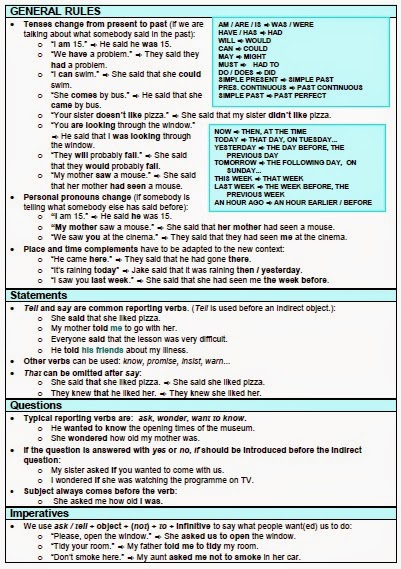
Revision of reported speech
GENERAL RULES FOR REPORTED SPEECH


- Tenses change from present to past (if we are talking about what somebody said in the past):
- “I am 15.” - He said he was 15.
- “We have a problem.” - They said they had a problem.
- “I can swim.” - She said that she could swim.
- “She comes by bus.” - He said that she came by bus.
- “Your sister doesn’t like pizza.” - She said that my sister didn’t like pizza.
- “You are looking through the window.” - He said that I was looking through the window.
- “They will probably fail.” - She said that they would probably fail.
- “My mother saw a mouse.” - She said that her mother had seen a mouse.
- Personal pronouns change (if somebody is tellingwhat somebody else has said before):
- “I am 15.” - He said he was 15.
- “My mother saw a mouse.” - She said that her mother had seen a mouse.
- “We saw you at the cinema.” - They said that they had seen me at the cinema.
- Place and time complements have to be adapted to the new context:
- He came here.” - They said that he had gone there.
- “It’s raining today” - Jake said that it was raining then / yesterday.
- “I saw you last week.” - She said that she had seen me the week before.
STATEMENTS
- Tell and say are common reporting verbs. (Tell is used before an indirect object.):
- She said that she liked pizza.
- My mother told me to go with her.
- Everyone said that the lesson was very difficult.
- He told his friends about my illness.
- Other verbs can be used: know, promise, insist, warn...
- That can be omitted after say:
- She said that she liked pizza. - She said she liked pizza.
- They knew that he liked her. - They knew she liked her.
QUESTIONS
- Typical reporting verbs are: ask, wonder, want to know.
- He wanted to know the opening times of the museum.
- She wondered how old my mother was.
- If the question is answered with yes or no, if should be introduced before the indirect question:
- My sister asked if you wanted to come with us.
- I wondered if she was watching the programme on TV.
- Subject always comes before the verb:
- She asked me how old I was.
IMPERATIVES
- We use ask / tell + object + (not) + to + infinitive to say what people want(ed) us to do:
- “Please, open the window.” - She asked us to open the window.
- “Tidy your room.” - My father told me to tidy my room.
- “Don’t smoke here.” - My aunt asked me not to smoke in her car.
Wednesday, April 23, 2014
World Book Day
It's world book day today.

World Book Day or World Book and Copyright Day (also known as International Day of the Book or World Book Days) is a yearly event on 23 April, organized by UNESCO to promote reading, publishing and copyright. In the United Kingdom, the day is instead recognised on the first Thursday in March.
Why do we celebrate World Book Day on the 23rd of April?
In 1923 booksellers in Spain decided to celebrate the date to honour Miguel de Cervantes who died on that day.
In 1995, UNESCO decided that the World Book and Copyright Day would be celebrated on this date the date is also the anniversary of the birth and death of William Shakespeare, the death of Miguel de Cervantes, Inca Garcilaso de la Vega and Josep Pla, and the birth of Maurice Druon, Manuel Mejía Vallejo and Halldór Laxness.
Although 23 April is often stated as the anniversary of the deaths of both William Shakespeare and Miguel de Cervantes, this is not strictly correct. Cervantes died on 22 April and was buried on 23 April according the Gregorian calendar; however, at this time England still used the Julian calendar. While Shakespeare died on 23 April by the Julian calendar in use in his own country at the time, he actually died eleven days after Cervantes because of the discrepancy between the two date systems. The apparent correspondence of the two dates was a fortunate coincidence for UNESCO. (information from Wikipedia)
Interesting links
Tuesday, April 22, 2014
What to say in special situations
Do you know when you should say, good luck, bad luck, congratulations or happy birthday?
If you are not sure you might read the following page at English at home to check them and later on you might try the test to make sure you can use them properly.
Good luck!
Monday, April 14, 2014
Dialogues in English for EFL students
This blog has an interesting page with lots of dialogues in common situations we may come accross if we visit a foreign country. Just have a look.
 |
| http://blogpara-aprenderingles.blogspot.it/p/dialogos-en-ingles.html |
Sunday, April 13, 2014
Easter in the United Kingdom
 Easter in celebrated in the spring in Christian areas. Therefore it is also celebrated in the United Kingdom.
- The BBC website will let you know more about Lent in the United Kingdom.
- This other page in the BBC website is about Easter in the United Kingdom.
- Isabel Pérez has lots of interesting resources to learn about Easter and Easter traditions in Spain and in English-speaking countries.
Tuesday, April 8, 2014
Revision of modal verbs: can, should & must
MODAL VERBS
Modal verbs are commonly used verbs with some special characteristics:

WHICH VERBS ARE MODAL?:
EXERCISES:
Modal verbs are commonly used verbs with some special characteristics:
- Modal verbs do not take "-s" in the third person.
- I can play football.
- My brother should go with you.
- She can't be serious about that.
- They have their own negative and do not need "do".
- I shouldn't be late
- They can't drive.
- You couldn't swim when you were 3.
- The don't have all the tenses other verbs have.
- I will can go.- INCORRECT
- They shoulded speak to her. - INCORRECT
- They are always followed by another verb (bare infinitive)
WHICH VERBS ARE MODAL?:
- CAN / CAN'T
- MUST / MUSTN'T
- SHOULD / SHOULDN'T
- NEED / NEEDN'T
- SHALL / SHAN'T
- COULD / COULDN'T
- MAY / MAY NOT
- MIGHT / MIGHTN'T
- WILL / WON'T
- OUGHT TO
EXERCISES:
Subscribe to:
Posts (Atom)