This blog has been designed to provide information about the activities held at the social studies bilingual sections in CPI Tino Grandío (Guntín,Spain). The English language and Social Studies teachers have elaborated most of the resources you can see but our "auxiliares de conversa" also have their own page and posts. Therefore everyone is invited to have a look .
Showing posts with label Youtube. Show all posts

Sunday, November 10, 2019

Winds of change

Listen and read the lyrics. What is the song about?

I follow the Moskva
And down to Gorky Park
Listening to the wind of change
An August summer night
Soldiers passing by
Listening to the wind of change
The world is closing in
And did you ever think
That we could be so close, like brothers
The future's in the air
I can feel it everywhere
Blowing with the wind of change
Take me to the magic of the moment
On a glory night
Where the children of tomorrow dream away
In the wind of change
Walking down the street
And distant memories
Are buried in the past forever
I follow the Moskva
And down to Gorky Park
Listening to the wind of change
Take me to the magic of the moment
On a glory night
Where the children of tomorrow share their dreams
With you and me
Take me to the magic of the moment
On a glory night
Where the children of tomorrow dream away
In the wind of change
The wind of change blows straight
Into the face of time
Like a storm wind that will ring
The freedom bell for peace of mind
Let your balalaika sing
What my guitar wants to say
Take me to the magic of the moment
On a glory night
Where the children of tomorrow share their dreams
With you and me
Take me to the magic of the moment
On a glory night
Where the children of tomorrow dream away
In the wind of change


Sunday, April 22, 2018

Earth Day Doodle

Watch this video (without or with subtitles) and try to answer the following questions:


SOME QUESTIONS:
  • Can you say something about Jane Goodall's childhood?
  • How did Jane feel one day at Gombe National Park?
  • What is her message to all of us?

Saturday, April 7, 2018

Environment


SOME QUESTIONS:
  • Do you think this idea is feasible? Why?
  • What will the most important problems be?
  • Can you think of any other good ideas to keep our environment cleaner?

Tuesday, April 3, 2018

Reported Speech

GENERAL RULES FOR REPORTED SPEECH
  • Tenses change from present to past (if we are talking about what somebody said in the past):
    • am 15.”  He said he was 15.
    • We have a problem.” They said they had a problem.
    • can swim.”  She said that she could swim.
    • She comes by bus.”  He said that she came by bus.
    • Your sister doesn’t like pizza.”  She said that my sister didn’t like pizza.
    • You are looking through the window.”  He said that I was looking through the window.
    • They will probably fail.”  She said that they would probably fail.
    • My mother saw a mouse.”  She said that her mother had seen a mouse.
  • Personal pronouns change (if somebody is telling
    what somebody else has said before):
    • I am 15.”  He said he was 15.
    • My mother saw a mouse.”  She said that her mother had seen a mouse.
    • We saw you at the cinema.”  They said that they had seen me at the cinema.
  • Place and time complements have to be adapted to the new context:
    • He came here.” ⇨ They said that he had gone there. 
    • It’s raining today”  Jake said that it was raining then / yesterday.
    • I saw you last week.” ⇨ She said that she had seen me the week before.
STATEMENTS

  • Tell and say are common reporting verbs. (Tell is used before an indirect object.):
    • She said that she liked pizza.
    • My mother told me to go with her.
    • Everyone said that the lesson was very difficult.
    • He told his friends about my illness.

  • Other verbs can be used: know, promise, insist, warn...
  • That can be omitted after say:
    • She said that she liked pizza. She said she liked pizza.
    • They knew that he liked her. They knew she liked her.
QUESTIONS

  • Typical reporting verbs are: ask, wonder, want to know.
    • He wanted to know the opening times of the museum.
    • She wondered how old my mother was.
  • Subject always comes before the verb:
    • She asked me how old I was.
  • If the question is answered with yes or no, if should be introduced before the indirect question:
    • My sister asked if you wanted to come with us.
    • I wondered if she was watching the programme on TV.
  • If the questions cannot be answered with yes or no, and usually begins with how / when / what / where  / who / how old... you keep this element in the reported speech and don't add if:
    • He asked me "What is your name? " ⇒ He asked me what my name was.
    • My mother asked me: "What time did you arrive?" ⇒ My mother asked me what time I had arrived.
    • Gina asked: "When will you come tomorrow?" ⇒ Gina asked when I would come / go the following day.
  • We use ask / tell + object + (not) + to + infinitive to say what people want(ed) us to do:
  • Please, open the window.” ⇨ She asked us to open the window.
  • Tidy your room.” ⇨ My father told me to tidy my room.
  • Don’t smoke here.” ⇨ My aunt asked me not to smoke in her car.

Thursday, February 15, 2018

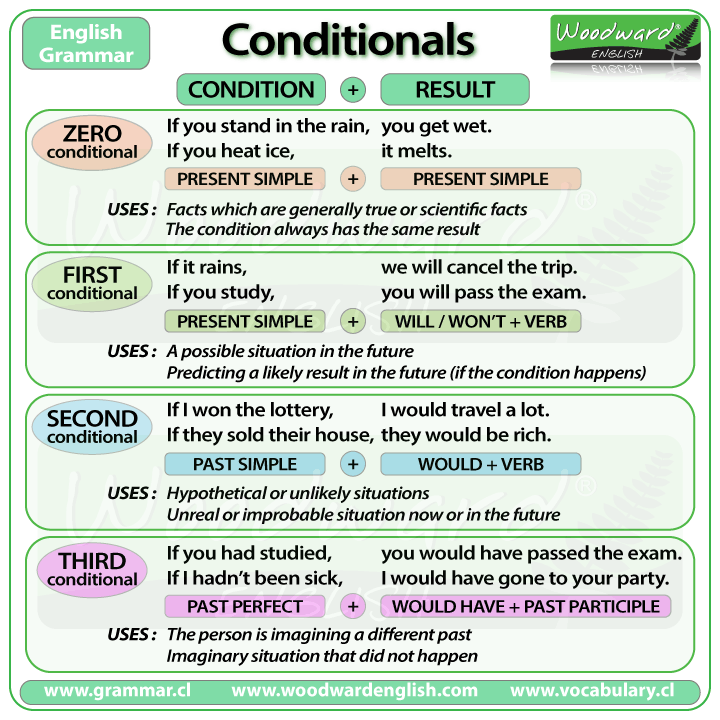
1st and 2nd type conditional sentences

1st and 2nd type conditional sentences


ZERO TYPE CONDITIONAL SENTENCES

MEANING& USE
The zero conditional is used to make statements about the real world, and often refers to general truths, such as scientific facts. In these sentences, the time is the present or always and the situation is real and possible.
  • If you heat water, it boils.
  • Water boils if you heat it.
  • When you heat ice, it melts.
  • Ice melts when you heat it.
  • If it snows, the grass gets white.
  • The grass gets white if it snows.
  • When it rains, the grass gets wet.
  • The grass gets wet when it rains.

FORM
We can make a zero conditional sentence with two present simple verbs (one in the 'if clause' and one in the 'main clause'):

  • If/when/unless + present simple, .... present simple.
EXERCISES
1ST TYPE CONDITIONAL SENTENCES

MEANING & USE
The first conditional is also called the "real" conditional because it is used for real, or possible, situations. These situations take place if a certain condition is met.

In the first conditional we can salso use unless, which means "if... not". In other words, "... unless he hurries up" could also be written, "... if he doesn't hurry up."
1st type conditional sentence
  • If it rains, we will stay at home.
  • He will arrive late unless he hurries up.
  • Sophie will buy a new car, if she gets her raise.


FORM
The first conditional is formed by the use of the present simple in the if clause followed by a comma and a future simple verb (will + infinitive) in the result clause. You can also put the result clause first without using a comma between the clauses.
  • If he finishes on time, we will go to the movies.
OR
  • We will go to the movies if he finishes on time.
EXERCISES

2nd TYPE CONDITIONAL SENTENCES

MEANING
2nd type conditional sentence
The second conditional is used to talk about situations or actions in the present or future which are not likely to happen or are imaginary, hypothetical or impossible.


  • If I were a rich woman, I would travel around the world. I think it is very unlikely that I will be rich. However, in this unlikely condition, I will travel around the world.
  • If I weren't / wasn't watching TV now, I would be playing tennis. I am watching TV, but I am imagining an alternative activity I would be doing if I wasn't watching TV
  • If you had a bigger dog, your house would be protected. You don't have a big dog, but I am imagining how protected you would be if you had one.
  • If I were an alien, I would be able to travel around the universe. It is impossible for me to be an alien. However, I am imagining what I would do in this situation.
  • We would go to Paris this summer if we passed all our subjects. That is our plan but, unfortunatelly,  we know we are not going to pass all our subjects.
FORM
If + past simple + conditional (would)
Conditional (would) if + past simple
Verb be is usually were for all subjects; was (1st & 3rd person) is colloquial.

SONGS
If I were a rich man (Fiddler in the Roof-movie)
If I were a boy (Beyonce)

EXERCISES
- Malted ESO-4 unit 7 (Gwineth and the Wizard)


Tuesday, January 23, 2018

Friday, January 19, 2018

Conditional sentences in English


ZERO TYPE CONDITIONAL SENTENCES

MEANING& USE
The zero conditional is used to make statements about the real world, and often refers to general truths, such as scientific facts. In these sentences, the time is the present or always and the situation is real and possible.
  • If you heat water, it boils.
  • Water boils if you heat it.
  • When you heat ice, it melts.
  • Ice melts when you heat it.
  • If it snows, the grass gets white.
  • The grass gets white if it snows.
  • When it rains, the grass gets wet.
  • The grass gets wet when it rains.

FORM
We can make a zero conditional sentence with two present simple verbs (one in the 'if clause' and one in the 'main clause'):

If/when/unless + present simple, .... present simple.

EXERCISES
1ST TYPE CONDITIONAL SENTENCES

MEANING & USE
The first conditional is also called the "real" conditional because it is used for real, or possible, situations. These situations take place if a certain condition is met.

In the first conditional we can salso use unless, which means "if... not". In other words, "... unless he hurries up" could also be written, "... if he doesn't hurry up."
1st type conditional sentence
  • If it rains, we will stay at home.
  • He will arrive late unless he hurries up.
  • Sophie will buy a new car, if she gets her raise.


FORM
The first conditional is formed by the use of the present simple in the if clause followed by a comma and a future simple verb (will + infinitive) in the result clause. You can also put the result clause first without using a comma between the clauses.
  • If he finishes on time, we will go to the movies.
OR
  • We will go to the movies if he finishes on time.

EXERCISES

2nd TYPE CONDITIONAL SENTENCES

MEANING
2nd type conditional sentence
The second conditional is used to talk about situations or actions in the present or future which are not likely to happen or are imaginary, hypothetical or impossible.


  • If I were a rich woman, I would travel around the world. I think it is very unlikely that I will be rich. However, in this unlikely condition, I will travel around the world.
  • If I weren't / wasn't watching TV now, I would be playing tennis. I am watching TV, but I am imagining an alternative activity I would be doing if I wasn't watching TV
  • If you had a bigger dog, your house would be protected. You don't have a big dog, but I am imagining how protected you would be if you had one.
  • If I were an alien, I would be able to travel around the universe. It is impossible for me to be an alien. However, I am imagining what I would do in this situation.
  • We would go to Paris this summer if we passed all our subjects. That is our plan but, unfortunatelly,  we know we are not going to pass all our subjects.
FORM
If + past simple + conditional (would)
Conditional (would) if + past simple
Verb be is usually were for all subjects; was (1st & 3rd person) is colloquial.

SONGS
If I were a rich man (Fiddler in the Roof-movie)
If I were a boy (Beyonce)

EXERCISES
- Malted ESO-4 unit 7 (Gwineth and the Wizard)


3RD TYPE CONDITIONAL SENTENCES

MEANING
The first conditional and second conditionals tell us about the future. With the third conditional we refer to the past. We speak about a condition in the past that did not happen. That is why there is no possibility for this condition. The third conditional is also like a dream, but with no possibility of the dream coming true.
  • If I had travelled to Italy I would have visited LucaBut I have not travelled to Italy and, therefore, I have not visited Luca.
  • If you had got a good mark, would you have complained to the teacher? but your mark was bad, so we don't know for sure what you would have done.
  • What would you have done if it had snowed last weekend? but it didn't snow.
  • I wouldn't have called if I had known that she wasn't home. but I knew so I called
FORM
If + past perfect  // would have + past participle
Past participle // if + past perfect

EXERCISES


ALL TYPES OF CONDITIONALS

Sunday, December 31, 2017

New Year's Day

The New Year is widely celebrated in countries that share our calendar and, thus, start the New Year on the 1st of January every year.

In English-speaking countries most people sing "Auld Lang Syne" as the new year begins. This poem was composed by Scottish poet Robert Burns and was made popular by Scottish immigrants in Canada.

In the USA probably the most famous tradition is the dropping of the New Year ball in Times Square, New York City, at 11:59 P.M. Thousands of people watch the ball make its one-minute descent, arriving exactly at midnight. The tradition first began in 1907. 


There are other common traditions all over the world:

New Year's Resolutions: It is believed that the Babylonians were the first to make New Year's resolutions, and people all over the world have been breaking them ever since. The early Christians believed the first day of the new year should be spent reflecting on past mistakes and resolving to improve oneself in the new year.

Fireworks: Noisemaking and fireworks on New Year's eve is believed to have originated in ancient times, when noise and fire were thought to dispel evil spirits and bring good luck. The Chinese are credited with inventing fireworks and use them to spectacular effect in their New Year's celebrations.

Read More:

Tuesday, December 19, 2017

Ed Sheeran's "Perfect"


  1. Listen to the song. What have you understood?
    1. What type of song is it? Love? Absence? A poem?
  2. Some vocabulary before you listen a second time:
    1. follow one's lead: follow someone
    2. the someone: the person
    3. to give up: to leave, to quit, to abandon
    4. to own: to have
    5. barefoot: with no shoes, with nothing on one's feet
    6. to look a mess: to look horrible
    7. to whisper: to speak in a low voice
    8. underneath: under
    9. to share: to have the same
    10. of our own: our
    11. against all odds: in spite of all likelihood against one; even if it didn't seem probable
    12. to deserve: to be worthy of
    13. to have faith in something: to believe something
  3. Listen again and try to answer these questions:
    1. What do we know about their past?
    2. What do we know about their future?

LYRICS:

I found a love for me
Darling, just dive right in and follow my lead
Well, I found a girl, beautiful and sweet
Oh, I never knew you were the someone waiting for me

'Cause we were just kids when we fell in love
Not knowing what it was
I will not give you up this time
But darling, just kiss me slow
Your heart is all I own
And in your eyes you're holding mine

Baby, I'm dancing in the dark
With you between my arms
Barefoot on the grass
Listening to our favourite song
When you said you looked a mess
I whispered underneath my breath
But you heard it,
Darling, you look perfect tonight

Well, I found a woman, stronger than anyone I know
She shares my dreams, I hope that someday I'll share her home
I found a love to carry more than just my secrets
To carry love, to carry children of our own

We are still kids but we're so in love
Fighting against all odds
I know we'll be alright this time
Darling, just hold my hand
Be my girl, I'll be your man
I see my future in your eyes

Baby, I'm dancing in the dark
With you between my arms
Barefoot on the grass
Listening to our favourite song
When I saw you in that dress
Looking so beautiful
I don't deserve this
Darling, you look perfect tonight

Baby, I'm dancing in the dark
With you between my arms
Barefoot on the grass
Listening to our favourite song
I have faith in what I see
Now I know I have met an angel in person
And she looks perfect
I don't deserve this
You look perfect tonight

Saturday, November 11, 2017

British and American money

Some vocabulary about money:

This presentation by Taylor shows the different coins and bills used in the USA:


And this other video and presentation will tell you about British money:


Thursday, October 5, 2017

The Big Bang Theory theme song - key

BEFORE LISTENING: Write the past tense of these infinitives:
  • be X 4: was / were
  • begin X 2: began
  • build X 2: built
  • develop: developed
  • die: died
  • freeze: froze
  • meet: met
  • set: set
  • stand: stood
  • start X 3: started
  • try: tried

WHILE LISTENING: Complete the lyrics with the missing past tense forms you have written down before:


Our whole universe was in a hot dense state,
Then nearly fourteen billion years ago expansion started. Wait...
The Earth began to cool,
The autotrophs began to drool,
Neanderthals developed tools,
We built a wall (we built the pyramids),
Math, science, history, unraveling the mystery,
That all started with the big bang (bang)!

"Since the dawn of man" is really not that long,
As every galaxy was formed in less time than it takes to sing this song.
A fraction of a second and the elements were made.
The bipeds stood up straight,
The dinosaurs all met their fate,
They tried to leap but they were late
And they all died (they froze their asses off)
The oceans and Pangaea
See ya wouldn't wanna be ya
Set in motion by the same big bang!

It all started with the big bang!

AFTER LISTENING: Now listen to the song again and check.